Why AI Sounds Like AI: The Perplexity Problem

Moe
·Updated ·7 min read

What Perplexity Actually Means
Perplexity measures how surprised a language model is by the next word in a sequence. Low perplexity means the model felt confident about what came next. High perplexity means the model was genuinely uncertain.
But here's the thing: a language model's confidence is just probability. It's not wisdom or creativity. It's math. The model looks at billions of training tokens, calculates which word appears most often in similar contexts, and picks that word. Repeat a billion times. You get a completed text.
Humans don't work that way. Your brain has grammar, memory, intention, whims, and moods. You might choose a less common word because it fits the rhythm better, because it's more precise, or because you're just in the mood to surprise yourself. That variation comes from somewhere other than pure statistical likelihood.
Why AI Models Have Low Perplexity
An AI language model's job during training is to predict the next token as accurately as possible. The loss function rewards confidence in the most probable outcome. Over millions of iterations, the model learns to compress its uncertainty and commit hard to the statistically safest choice.
This is intentional. It's not a bug. Models are trained to minimize perplexity because low perplexity means good predictions. But good predictions and natural writing are not the same thing.
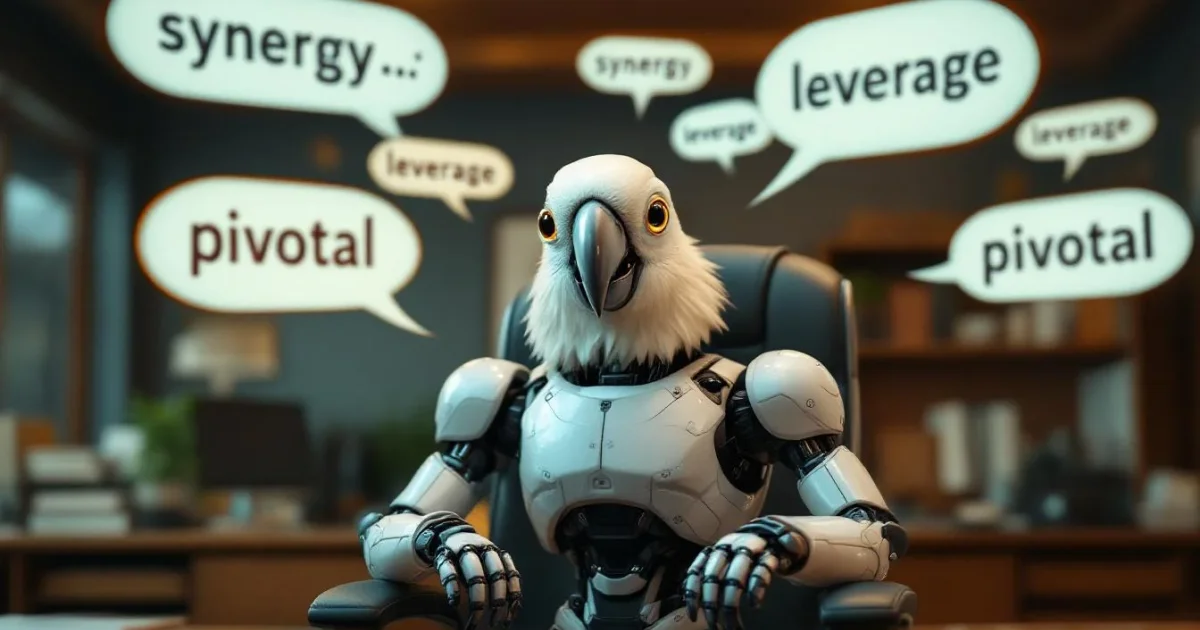
Consider the word "leverage." If you trained a model on a corpus of business writing, startup pitch decks, and corporate emails, the model would learn that "leverage" appears constantly. Millions of times. In context after context, the model sees a sentence about using something to achieve an outcome, and 40% of the time the training data used "leverage." The model learns this association so deeply that when it generates similar text, "leverage" becomes the statistically dominant choice. It's not trying to sound corporate. It's just following probability.
The model could pick "use," "employ," "harness," "deploy," "mobilize," or "apply." All are grammatically correct. All fit the context. But they don't have the same frequency signal in the training data. So the model doesn't pick them. Not because it can't. Because it's optimized not to.
How Human Perplexity Works Differently
When you write, your next word choice comes from multiple competing systems. Grammar is one. Statistical likelihood is another. But so are style, rhythm, intent, emotion, vocabulary size, and conscious deliberation.
Humans have much higher perplexity because many words feel like viable options. You might write "the team gathered in the conference room" or "the team huddled in the conference room" or "the team crowded into the conference room." All are natural. All convey slightly different feeling. Your brain didn't weight "gathered" at 60% probability and the others at lower weights. You cycled through options and picked one based on something other than frequency.
You also have access to an enormous vocabulary spread across different domains, time periods, and registers. You read technical papers, noir novels, poetry, tweets, chat logs, historical texts, comic books. That diversity in training data (your life experience) gives you way more options to choose from at every step. An AI model trained on internet text has broad coverage, but it's skewed heavily toward contemporary, high-volume sources. Technical writing, sales copy, news articles, social media.
High human perplexity is a feature. It's where personality, style, and originality come from. Low AI perplexity is a liability. It's where the robotic sameness comes from.
The Word Variation Problem in AI Output
This is why AI writing feels repetitive and bland even when it's grammatically correct and coherent. The model isn't just picking the safest word once. It's doing that at every single token.
Read an AI-generated paragraph and highlight the most common words. "Provide," "offer," "ensure," "important," "digital," "innovative." Now read a paragraph from a skilled human writer. The sentence structure varies. The adjectives vary. The verbs have texture. One paragraph uses "sinking" where another uses "eroding." One uses "fumbled" where another uses "lost track of."
AI models struggle with this for a specific reason. During training, the model learns that synonyms are interchangeable from a prediction standpoint. "The company provides solutions" and "The company offers solutions" both appear in training data. From the model's perspective, they're equivalent outcomes. So when it gets to the verb slot, if "provides" has slightly higher frequency, that's what gets picked. No reason to pick the lower-probability option if the goal is to minimize perplexity.
You can observe this yourself. Prompt any major language model with the same request five times and you get nearly identical outputs. Try that with a human. Five different versions, each valid, each with different word choices and emphasis. Humans have too much perplexity to nail the same output twice.
Why Lower Perplexity Doesn't Mean Better Writing
This is the paradox that breaks a lot of AI writing systems. Optimizing for low perplexity makes models worse writers, not better ones.
Low perplexity is useful for some tasks. If you want a model to accurately predict the next word in a benchmark dataset, low perplexity is the signal you want. But writing that feels alive, that surprises and engages, that sounds like it came from an actual person? That requires higher perplexity. It requires the model to sometimes pick a less probable word because it fits better.
Some researchers have tried temperature sampling to address this. You crank up the "temperature" parameter to make the model less confident, more exploratory. But that's a crude fix. A high temperature makes the model unpredictable in ways that are often just incoherent. You don't get natural variation. You get random garbage.
The deeper issue is the training objective itself. Models are not trained to write like humans. They're trained to predict the next token with maximum accuracy. These are different problems with different solutions.
What Actually Fixes Low Perplexity Output
Better fine-tuning data helps. If you train a model on writing from diverse authors with distinct styles, it learns more word variation is acceptable. It learns that "wander" and "roam" and "meander" all appear in high-quality text. The probability distribution becomes flatter. More uncertainty at each step. That uncertainty is actually the feature you want.
Instruction tuning toward human preference also shifts this. If human raters consistently prefer text with higher variation, with less repetition, with more word diversity, then fine-tuning on that signal teaches the model that low perplexity output is actually wrong. It's not what humans want.
This is partly why newer models feel more natural than earlier ones. Not because they're more powerful in raw capability, but because their training objectives have shifted slightly. They're optimized less purely on next-token prediction and more on "would a human prefer this." That human preference signal includes a penalty for repetitive, low-perplexity output.
The real fix is recognizing that perplexity is a metric for prediction accuracy, not writing quality. They're related but different. You can have high perplexity and still write coherently. In fact, you have to.
The Practical Takeaway
When you use an AI writing tool and the output feels generic, robotic, or repetitive, you're seeing low perplexity in action. The model is picking the statistically safest word at every step. It's not a bug in the model. It's the feature it was built to optimize for.
You can work around it by being specific about style. "Write this like a bad internet comment" gives the model a different target distribution than "write this professionally." You can also cherry-pick phrases and edit heavily, forcing the model to operate at higher perplexity by building on less obvious continuations.
But the core issue remains. Language models are optimized for prediction, not for the kind of high-perplexity exploration that makes human writing feel alive. Until training objectives shift more toward that goal, AI writing will keep feeling like AI writing.
Related Articles

AI Writing & Content
AI Slop Is Everywhere. Shut The Fluff Up!
AI slop is the bloated, lifeless output that plagues every chatbot interaction. Here's what causes it and how to fight back.
Mar 29, 2026·8 min read

AI Writing & Content
AI Burstiness: Why Your Model Writes Like a Robot
AI models struggle with burstiness, the natural rhythm of human writing. Here's why AI defaults to flat, predictable sentence length and how to fix it.
Mar 29, 2026·5 min read