AI Jargon: Why Models Want to Underscore Everything

Moe
·Updated ·7 min read
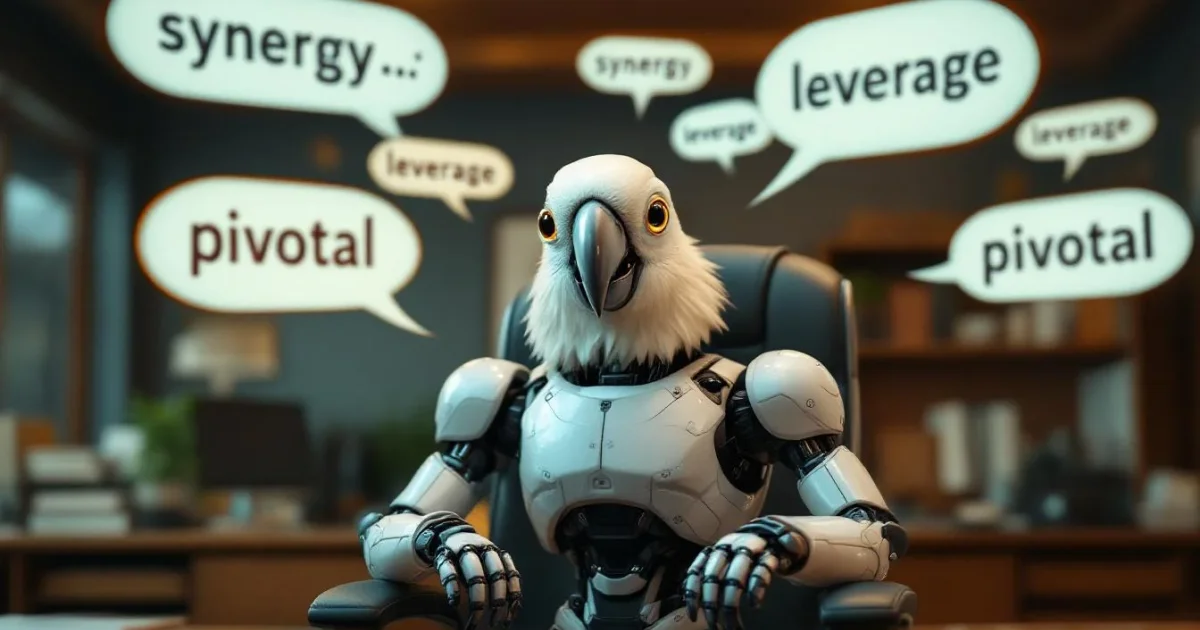
You Can Spot AI Text Before You Even Read It
There's a specific feeling you get reading AI-generated content. Something's off before you can name it. Then you clock the word 'underscore' in paragraph two, 'realm' in paragraph four, and a 'pivotal moment' somewhere in the middle. That's AI jargon doing what it always does: announcing itself.
This isn't about the model being dumb. It's about how language models work at a mechanical level. And once you understand that, you'll see these patterns everywhere.
What Is AI Jargon, Exactly?
AI jargon refers to the specific words and phrases that AI models default to with suspicious regularity. Not because they're the best word for the job, but because they're statistically safe. These are the high-frequency, broadly applicable, vaguely formal terms that appear constantly in the text that AI models trained on.
Think of it like this: a model learns language by predicting what word comes next. If 'underscore' appeared after 'this finding' ten thousand times in the training data, the model learns that pairing is a good bet. It's not choosing words with intention. It's choosing words with probability.
The result is a recognizable vocabulary that signals AI text almost as clearly as a watermark. Once you've seen it, you can't unsee it.
The Full List of Common AI Vocabulary You'll See Everywhere
This isn't a short list. AI models have a surprisingly large repertoire of go-to words, and they rotate through them freely. Here's a breakdown of the most overused AI vocabulary, grouped by type.
Verbs That Sound Important But Say Nothing
Underscore — Used when 'show' or 'highlight' would do fine. Beloved for sounding academic.
Leverage — AI can't stop leveraging things. Tools, data, frameworks, opportunities. All of them.
Delve — A dramatic way to say 'look into.' Rarely used by real humans writing naturally.
Harness — Usually paired with 'the power of.' Red flag every time.
Embark — As in 'embark on a journey.' Signals an AI intro paragraph from a mile away.
Facilitate — A corporate verb that AI adopted wholesale. Usually replaceable with 'help.'
Navigate — Used metaphorically for everything. Navigating challenges, complexity, the landscape.
Elucidate — A fancy word for 'explain' that almost nobody uses in real conversation.
Cultivate — Often appears in AI text about growth, relationships, or skills.
Mitigate — Risk mitigation is a corporate staple. AI writes like a compliance team.
Nouns That Blur Everything
Landscape — The AI landscape, the competitive landscape, the regulatory landscape. Every surface is a landscape.
Realm — A slightly more dramatic version of 'area' or 'field.' Overused to the point of parody.
Ecosystem — Tech has ecosystems. AI decided everything else does too.
Facet — A word that sounds precise while meaning almost nothing on its own.
Nuance — AI loves claiming to understand nuance. Ironically, actual nuance is what AI writing lacks.
Synergy — It never left. AI brought it back with full confidence.
Framework — Everything is a framework. Thinking frameworks, ethical frameworks, decision frameworks.
Stakeholder — Corporate jargon fully absorbed into common AI model jargon.
Paradigm — As in 'paradigm shift.' Usually paired with 'new' for maximum vagueness.
Trajectory — Paths are boring. AI prefers trajectories.
Adjectives That Inflate Without Informing
Pivotal — Everything is pivotal. The moment, the role, the decision. None of it feels pivotal.
Groundbreaking — Reserved in real writing for truly rare things. In AI text, it appears weekly.
Robust — AI developers and AI models both love this word. It means thorough, but sounds tougher.
Comprehensive — The go-to adjective for making a list sound exhaustive. See also: 'holistic.'
Cutting-edge — A phrase that was fresh in 2005. Now it's how AI describes anything new.
Seamless — Integration is always seamless. Experiences are always seamless. Nothing is ever awkward.
Dynamic — Usually meaningless filler. The dynamic environment, the dynamic team.
Invaluable — Technically means 'too valuable to measure.' In practice, means 'useful.'
Multifaceted — A way of saying 'complicated' while sounding like you understand it.
Phrases That Trigger Immediate Suspicion
'In today's rapidly evolving world' — The most recognizable AI opening in existence.
'It's worth noting' — A throat-clearing phrase that adds nothing to the sentence.
'At the intersection of' — Used when trying to sound like a TED talk title.
'The importance of X cannot be overstated' — It almost certainly can be.
'In conclusion' — Real writers don't announce their conclusion. They just write it.
'This serves as a reminder' — Condescending and vague in equal measure.
'Foster a culture of' — Found in every AI-generated HR document and company blog post.
'Dive deeper into' — The aquatic cousin of 'delve.' Equally overused.
Why Do AI Models Default to These Words?
The short answer is that these words are statistically comfortable. They're common in formal writing, appear across many topics, and rarely create contradictions with surrounding text. A model trained to predict the next token finds these words to be low-risk choices across a huge range of contexts.
There's also the training data problem. Language models learned from massive amounts of online text, including corporate blogs, LinkedIn posts, academic abstracts, and product marketing copy. All of those formats are overrun with exactly this vocabulary. The model didn't invent these patterns. It absorbed them from the worst corners of professional writing on the internet.
Then there's the RLHF effect. Models trained with human feedback learned that raters often rate formal, polished-sounding text higher than casual text. So the model learned to sound 'professional.' The problem is that 'professional' in training data often means 'corporate,' and corporate writing loves words like 'leverage,' 'robust,' and 'stakeholder.'
The result is a feedback loop where the model gets rewarded for sounding a certain way, doubles down on that style, and produces text that sounds increasingly like a press release written by committee.
The 'Lens' Problem: When Metaphors Become Defaults
One specific category worth calling out is the metaphor-as-default pattern. AI models love framing things through a 'lens.' Examining something through a critical lens, a historical lens, an economic lens. It's not wrong, exactly. But it's a crutch.
The same goes for 'realm' and 'landscape.' These spatial metaphors appear because they're broadly applicable. You can drop 'the realm of AI ethics' into almost any paragraph and it grammatically fits. That's the point. It fits everywhere, which means it's precise nowhere.
Real writers use metaphors deliberately, when they clarify something that's hard to explain literally. AI models use them habitually, because they tested well across enough training examples to become defaults. The difference is intention versus probability.
How to Spot AI Text Using Jargon Patterns
You don't need a detection tool. You need to know what to look for.
Start with the opening paragraph. If it mentions 'today's rapidly evolving world,' 'the intersection of,' or kicks off with a definition ('X is a term that refers to...'), the model wrote it. Real writers start in the middle of things.
Then look for adjective density. Sentences loaded with 'pivotal,' 'robust,' and 'comprehensive' in close proximity signal AI text reliably. A human writer might use one of those words in a piece. Three in a paragraph is a pattern.
Watch for verb choices too. 'Underscore,' 'leverage,' and 'facilitate' are all perfectly valid English words. But when they show up together in a single piece of content, something statistical happened. A human writer would have said 'shows,' 'use,' and 'help' and moved on.
Finally, check the conclusion. If it starts with 'In conclusion' or wraps up with a broad statement about AI transforming the world, it's almost certainly AI text. Humans end things. AI models summarize them.
Why This Matters for Anyone Using AI to Write
If you're using AI tools to produce content, this vocabulary is working against you. Readers who consume a lot of written content develop pattern recognition for these phrases faster than you'd expect. The moment they spot 'delve' or 'underscore,' their trust in the content drops.
It's also an SEO consideration. Search engines are getting better at identifying low-quality, templated content. Text that reads like common AI model jargon hits all the same statistical patterns those systems are learning to flag.
The fix isn't complicated. Edit aggressively. Replace every 'leverage' with 'use.' Cut every 'it's worth noting.' Rewrite every opening that starts with a definition or a broad claim about the state of an industry. What's left will sound like a person wrote it, because a person did.
AI is a useful first draft tool. The jargon cleanup is just part of the job now.
Related Articles

AI Writing & Content
Why AI Sounds Like AI: The Perplexity Problem
AI models suffer from low perplexity. They pick the statistically safest word every time. That's why their output feels robotic. Here's what's actually happening.
Mar 29, 2026·7 min read
AI Writing & Content
AI Slop Is Everywhere. Shut The Fluff Up!
AI slop is the bloated, lifeless output that plagues every chatbot interaction. Here's what causes it and how to fight back.
Mar 29, 2026·8 min read